


The S&P 500 finished the year up 17.9%. Very good on an absolute basis but pitiful compared to the rest of the world ex-US which saw a 32.5% increase. This certainly challenges what pundits were boldly referring to as “American Exceptionalism” just one year ago and begs the question of who the Trump tariffs are punishing and whom they’re rewarding.
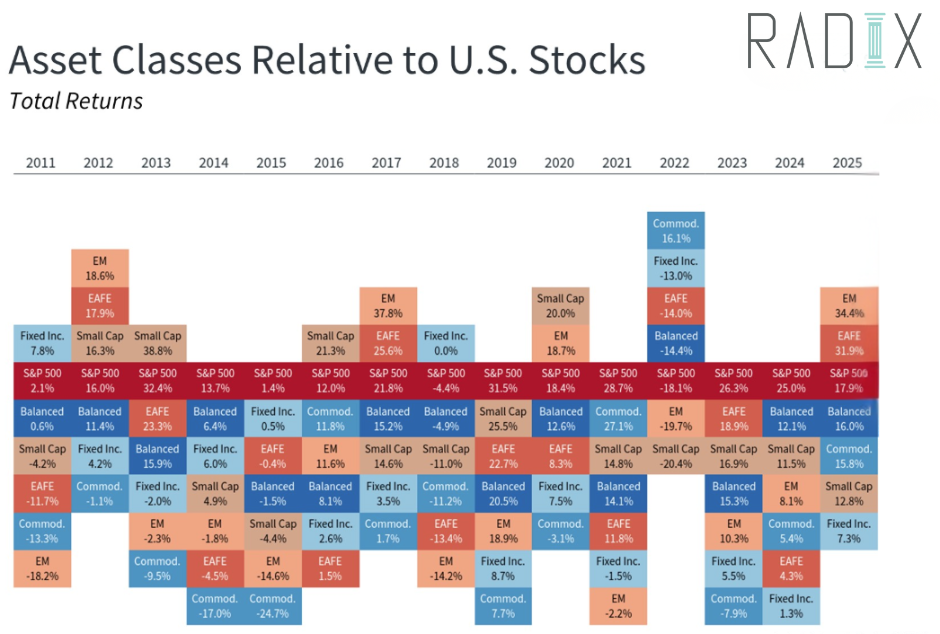
Here at Radix, the first half of 2025 was spent desperately trying to keep up with the intricacies of constitutional law and tariff policy…the second half was all GPUs and TPUs – aka the powerhouse computer chips (semiconductors) driving the AI revolution. As we head into 2026, identifying where these two mega themes intersect is where we’ll be looking to mine value.

To start, trying to follow the tech jargon on earnings calls and analyst reports has us feeling like Derek Zoolander and Hansel in the classic 2001 movie, where two male models try (unsuccessfully) to access incriminating files in the computer. However, 25 years later, what is IN THE COMPUTER (semiconductors) currently encompasses 13% of the global investable market. So – if you want to understand what’s driving global investment in 2026, there’s no escaping it.
Here’s how I understand it -
Virtually every electronic requires some type of silicon chip. Some things, like smart phones, need 25-30 of them, while modern cars may require thousands. But the real question for investors today is:
“How many chips do you need to train AI models?”
Unknown. But OpenAI founder Sam Altman, who already has well over one million GPUs in service, has indicated they need to figure out how to “100x that” – sweet music to our ears.
[pause here] I can tell I’ve lost some of you already, so if you’re still reading, let’s break it down.
Silicon semiconductor chips are how computers know how to do things, it’s how they process, store, share, and display data.
All computers have a brain called a CPU – think of the CPU as the Head Chef in a restaurant, they’re in charge and make the decisions. Head Chefs generally come from companies like Intel, AMD, Qualcomm, Samsung, and Apple. They can make all the dishes, but they can only make one dish at a time.
For high volume processes like 3D gaming or running AI models – you need line chefs (called GPUs) all working at the same time to allow the computer/restaurant to make a lot of different foods for many people simultaneously. But, while those GPU line chefs are versatile and can feed an army, they’re expensive – they consume a lot of power and require specialized cooling systems to keep them happy. All the major restaurants need line chefs, and in 2025, nearly all of them came straight from one place – Nvidia.
In recent months, we’re starting to see competitors emerge in the AI accelerator market beyond traditional CPUs and GPUs, generically called “XPUs” (programable) or “ASICS” (application specific/fixed), that could potentially challenge Nvidia’s market dominance.
For example, Amazon, and their Trainium chips, are designed specifically for training AI learning models on AWS. Similarly, Alphabet’s TPUs are purportedly faster, cheaper, and more energy efficient than their GPU counterparts, but they can’t prepare the whole menu. Think of TPUs like pizza chefs, baking only in custom pizza ovens (Google Cloud). They can only cook one thing, but they’re really good at it.
But at the end of the day…no chef, no restaurant, and no meal can happen without food. And in the chip world, food is only grown in one garden – Taiwan Semiconductor Manufacturing Company (TSMC).
That’s right. TSMC manufactures the metaphorical global food supply. While Silicon Valley firms do the legwork in chip design…they’re all “fabless,” meaning their designs are all sent overseas to an island off the southeast coast of China to be manufactured. That’s why escalating tensions in Taiwan pose, in our opinion, the biggest systematic risk to 2026 market returns.
The situation there is tense. China considers self-governing Taiwan to be theirs and continues to threaten a military ground invasion to remind them of Beijing’s love. The Taiwanese government has no desire to be re-unified, a position shared by both Japan and the United States. And while the U.S. is actively trying to reduce its dependence on offshore semiconductor manufacturing, through the 2022 CHIPS Act and a more recent public investment in Intel, these efforts take time to bear fruit. In the meantime, the global build-out of AI infrastructure remains highly dependent on TSMC, underscoring how concentrated and strategically important advanced chip manufacturing still is.
What does this all mean for portfolios?
Like every year, 2026 brings risk but also massive opportunity. The build-out of AI infrastructure is dominated by a small group of players, with leadership shifting based on capital intensity, technical capability, and execution. Firms with greater resources can invest more heavily in talent, hardware, and supporting infrastructure. However, and crucially, this remains a dynamic market and value creation will not be limited to a single winner. Expanding demand, infrastructure, and use cases are going to allow for many players, across all sectors, to generate attractive returns.
As we head into 2026, our focus remains on finding opportunities tied to long-term structural trends while maintaining diversified, resilient portfolios. We don’t chase headlines or build portfolios around one outcome. Instead, we emphasize balance, discipline, and staying invested through uncertainty.
Markets will surprise us again. Our job is not to predict those surprises, but to build portfolios designed to withstand them.
Happy New Year from the Radix team!