

Everything, Everywhere, All at Market

Happy October!
For those of you who have been following Radix for a while, you know that we generally reserve our Q3 commentary to explore something “new.” Whether it be new technology, investment opportunity, structure, account type, or medical breakthrough, we’ve tried to highlight them here.
We’re frankly also tired of reading, thinking, writing, and speaking about politics, AI, or interest rates. They’re important, but we’ve covered them ad nauseum, and there’s little we could add today that you couldn’t otherwise read in the newspaper.
What’s more interesting is what’s currently happening under the hood of traditional market mechanics, decentralized platforms, and prediction markets. As well as a surge in what we’d consider regulatory ‘experimentation’ with this new tech. Collectively, technology is making it easier to gain access to investing but potentially harder for these investors to differentiate “ownership” from “exposure.”
Consider how much has changed:
For most of market history, gaining exposure to the successor failure of a company generally meant owning its stock. Those days are gone! You can now trade/bet on a stock’s price, volatility, earnings, research trials, etc. through a prediction market app without owning a single share or opening a brokerage account. Or you can buy a synthetic token or single-stock ETF that will simulate a stock’s performance through derivatives or even leverage it 2x or 3x, why not? You don’t even have to know how to model these trades for yourself anymore, you can ask an AI agent to place the trades for you, soon around the clock, while you sleep.
Some of this is cool. Some of this is going to ruin lives. Best we learn how to benefit as intelligent investors before greed and FOMO (“fear of missing out”) sneak in and derail our goals.
What’s Happening?
1. Extended Trading Hours for Stocks and ETFs
The traditional 9:30-to-4:00 ET trading day is about to become only one part of a much longer U.S. trading day. The SEC has approved extended overnight trading for both NYSE Arca and Nasdaq, with the industry's supporting market-data infrastructure scheduled to expand to 23 hours a day/5days a week beginning December 6. Both exchanges plan to offer a new 9:00p.m.-to-4:00 a.m. overnight session, leaving only a one-hour daily pause between 8:00 and 9:00 p.m.
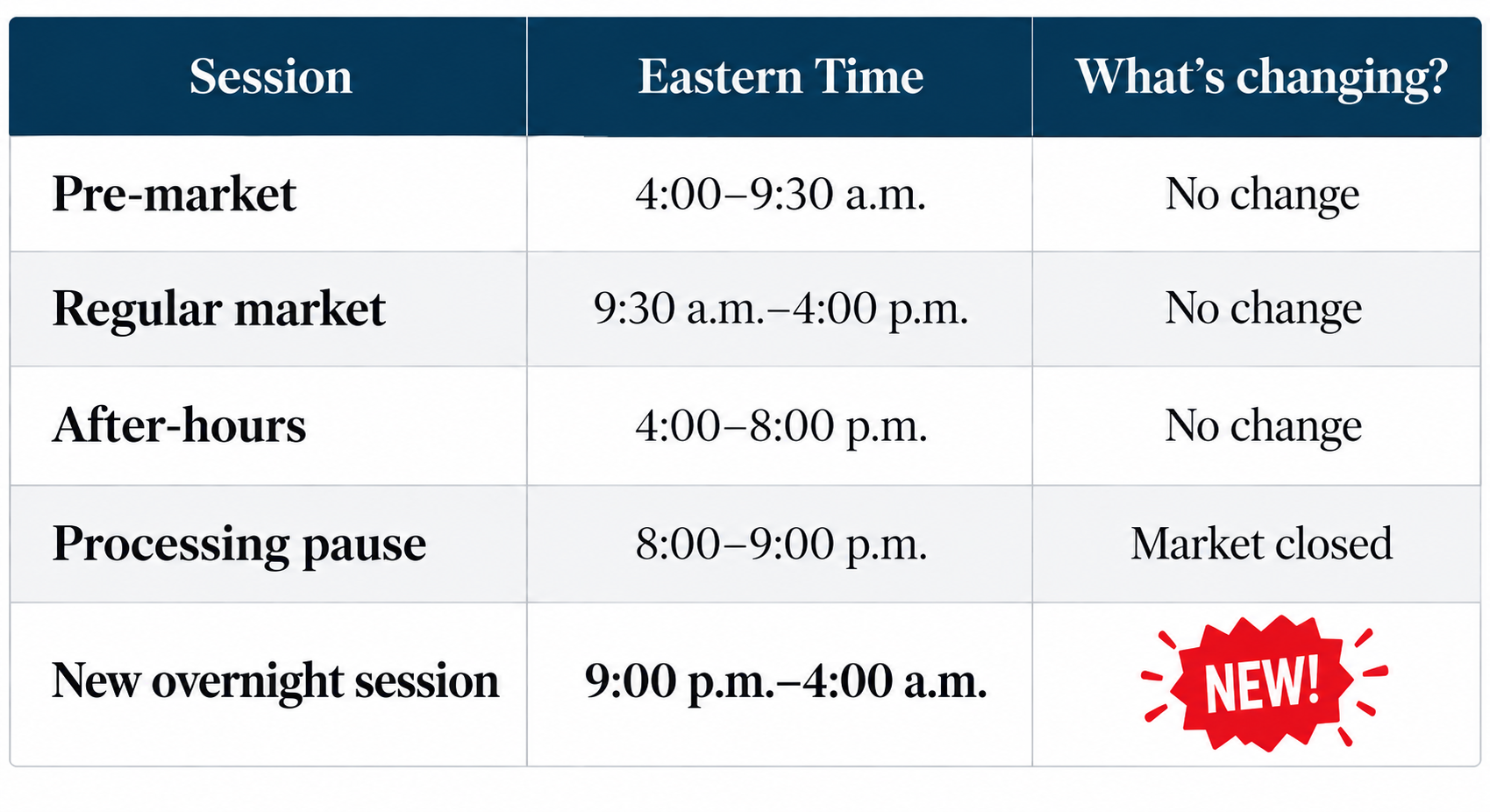
The change doesn’t mean that the NYSE floor—i.e. the traditional trading session—is suddenly staying open all night. Instead, U.S.-listed stocks will increasingly be available for overnight trading, expanding activity that already occurs through alternative trading venues.
Why do this? Three reasons:
1. increased international demand across time zones;
2. to remain competitive against cryptocurrency, tokenized assets, and other markets available 24/7; and
3. continuous price discovery.
SEC chairman Paul Atkins argued in September that longer trading hours would allow investors to “react more quickly to events, thereby reducing risk that accumulates overnight or over a weekend, while increasing market efficiency. Indeed, markets benefit when price discovery is not paused or distorted during periods of volatility.”
We’ll buy that I guess, but liquidity is still expected to remain concentrated during traditional market hours. So at least for now, Radix will continue to be available for trading only during daytime trading hours. Nice try, but we still need to sleep.
2. Tokenization
“Tokenization” is another topic that has been coming up frequently on panels, in webinars, and across other “future of finance” forums. But market participants are still in the very early stages of figuring out what adoption, implementation, and regulation will look like. Recently, the SEC broke the tokenized-securities world into three distinct categories, because calling something a “tokenized stock” tells you very little about what you actually own.
The first is issuer-sponsored tokenization, where the issuing company itself issues shares in tokenized form to trade on-chain. There are plenty of implementation questions, but in its simplest form—where nothing economically new is created and one token represents one share—the differenc eis largely one of recordkeeping and market infrastructure. Very few companies are doing this today, but we expect some issuers will begin experimenting with it.
Then, on September 17, the SEC issued a temporary, five-year “Innovation Exemption” allowing issuer-sponsored and certain third-party tokenized stocks to trade on permissioned blockchain platforms, called Tokenized Securities Venues “TSVs,” without being treated as an “exchange” and/or dealer under the Exchange Act. There are some important conditions. Each qualifying token must provide the same rights and privileges as the “real” share, including dividends and voting rights, which effectively requires the underlying shares to be held in custody. The underlying companies or ETF issuers can also object to unaffiliated third parties tokenizing their shares.
This is brand new, so it’s uncertain how receptive publicly traded companies will be to third parties creating blockchain-based representations of their shares. It is equally unclear whether investors will prefer tokens traded on a blockchain to shares held through established brokers/custodians. In theory, the five-year trial period gives both issuers and market infrastructure providers room to experiment, while potentially giving U.S. companies greater access to crypto-native pools of capital.
Lastly, there is third-party synthetic tokenization, which is already prevalent outside the United States. In this structure, the token issuer creates synthetic, and sometimes leveraged, exposure to a stock’s price through derivatives, but the token does not represent any direct or indirect ownership in the underlying company. They may look and trade like stocks, but they are fundamentally something different. Our view is simple: do not buy these.
3. Prediction Markets
Prediction markets, particularly the Polymarket and Kalshi platforms, have rapidly expanded this year beyond elections and sporting events into financial and economic outcomes. Monthly trading volume has exploded from roughly nothing in 2023, to $4.5 billion in September 2025, to $78 billion in September 2026.
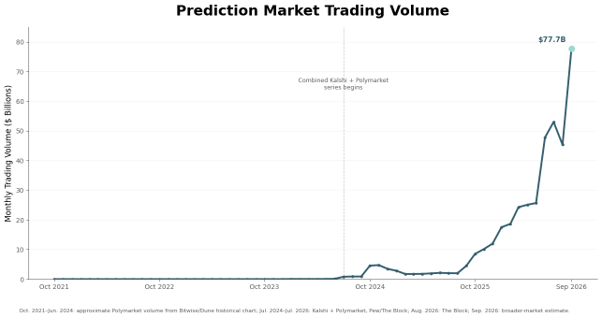
Understandably, regulators are scrambling to catch up. In June, the CFTC proposed a framework forreviewing event contracts that involve gaming, war, terrorism, or other illegalactivity contrary to the public interest, but to date, no such framework hasbeen finalized.
Prediction markets may provide useful information about what market participants collectively believe will happen, but we would proceed with extreme caution when treating them as investments. Where traditional derivatives derive their value from the price of an underlying asset, event contracts make it possible to create financial exposure to almost any measurable event, without owning anything underneath it. As these markets grow, we simply do not yet know their long-term impact, including whether sufficiently large markets designed to predict an event will eventually influence the price or behavior of the very assets and outcomes they are intended only to observe.
4. Agentic AI
I know we said we weren’t going to talk about AI…but artificial intelligence is quickly moving us in the direction of markets that don’t close combined with traders that don’t sleep. Robinhood told the Wall Street Journal that more than 150,000 customers have already opened agentic trading accounts since May, giving AI systems varying degrees of authority to research markets, develop strategies, and execute trades, even when users aren’t logged on.
We don’t view agentic trading much different than the “robo-advisor” threat that was supposedly going to put us out of business a decade ago. However, as AI models get smarter and trust in AI systems to handle more things (including money and buying behavior) on our behalf improves, the competitive landscape for financial services changes drastically.
Financial institutions run on inertia. The time and effort involved in comparing rates, opening accounts, transferring assets, changing insurers, or refinancing loans generally keeps customers exactly where they are. But what if an AI agent could continuously compare products and handle much of the work involved in switching? Customer authorization, identity checks and institutional access would still matter, but even with a final approval step, the administrative burden could shrink considerably. Providers, including financial advisors like us, may increasingly find themselves competing for the attention of both customers and the algorithms evaluating options on their behalf. That could put significant pressure on business models that depend on customers staying put.
And while we can’t predict how quickly this will evolve, the pace of institutional adoption, or what systemic effect AI agents will have on pricing power, fee margins, and broader customer acquisition economics; one thing is for sure, this is a lot bigger than simply whether AI can pick stocks better than a human.
5. Expanded Access to Private Offerings
On September 30th, the SEC proposed several changes designed to broaden retail access to private-market investments through regulated investment vehicles, while also considering new ways to qualify as an accredited investor based on financial knowledge or professional credentials rather than wealth levels alone. The stated purpose is “to increase investor choice and capital formation while preserving investor protections.”
We view broader private-market access a positive development, but access is not the same thing as ownership. Much, if not all, of this exposure will come through expensive funds and other intermediaries rather than direct stakes in individual businesses. And unlike a publicly traded stocks, private investments are difficult to value and impossible to sell “on demand.” Even an interval fund offering periodic redemptions cannot magically make an illiquid underlying asset truly liquid.
The Bottom Line
The market today is shifting from primarily facilitating the buying and selling of “ownership” towards a more decentralized buying and selling of “exposure” by new players, platforms, and structures. But complexity isn’t free. Every additional layer introduces another contract, another counterparty, another fee, and another assumption about how the system will behave when markets are under stress and liquidity is tightened.
We’re not shying away from financial innovation, but still strongly believe there must be a compelling reason to introduce (and pay a fee to) someone, or something, to stand between us and what we actually want to own.
The more complicated markets become, the simpler the questions investors need to ask:
What do I actually own?
Who am I relying on to get paid?
What could cause me to lose money?
How quickly can I get my money out, and at what cost?
How many intermediaries are standing between me and the asset?
What am I paying each of them?
Direct exposure has always been a cornerstone of our investment philosophy (see pillars). Where possible, we try to own the individual business or the bond ourselves. When size or tax-structure demands the use of an ETF – we utilize unleveraged low cost index funds from large issuers like Vanguard, Blackrock, and State Street who we’re comfortable can always offer us immediate liquidity.
In markets driven by leverage and greed…we think this commitment to buying and lending only to productive and profitable businesses, not speculative or derivative assets, is a competitive advantage. It’s also our promise to you, our clients.
As always, thank you for your confidence.
Amy & Jess